Sensors & outputs Position
TPS — 3-wire
Throttle position · sensor · Position
Rotary potentiometer. 5 V in, wiper out, sensor ground. Cable-throttle default is Analog Volt 2. An electronic throttle has two of these (TPS 1 and TPS 2) on split 5 V rails.
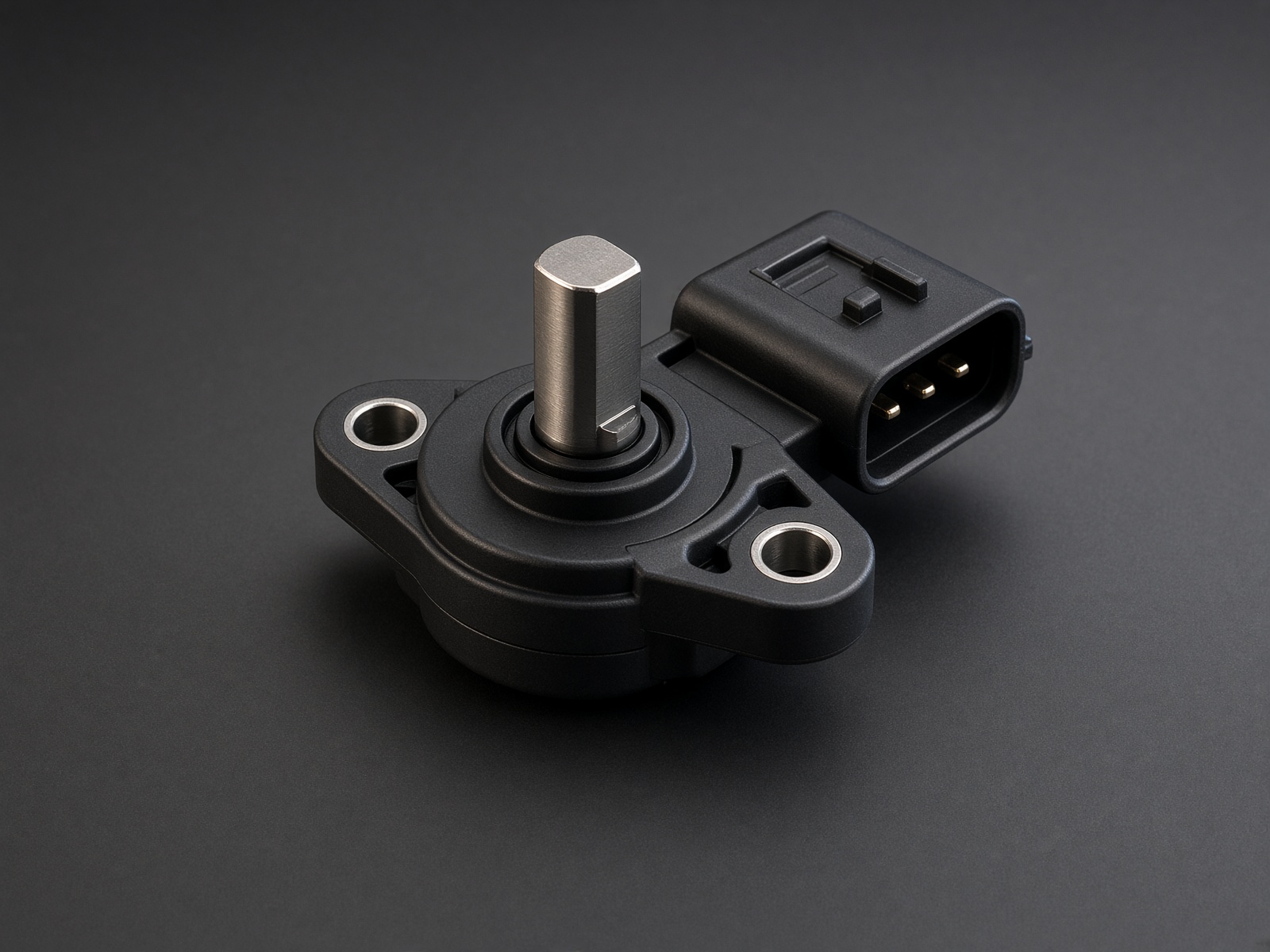
Typical parts: GM 3-wire rotary TPS; Bosch cable-throttle TPS; Ford blade TPS
Note — ETB is two sensors. See Electronic throttle for the 6-pin Bosch body. A cable TPS is this page.
Device pinout
Looking into the sensor, locking tab at the top. Pins A · B · C left to right.
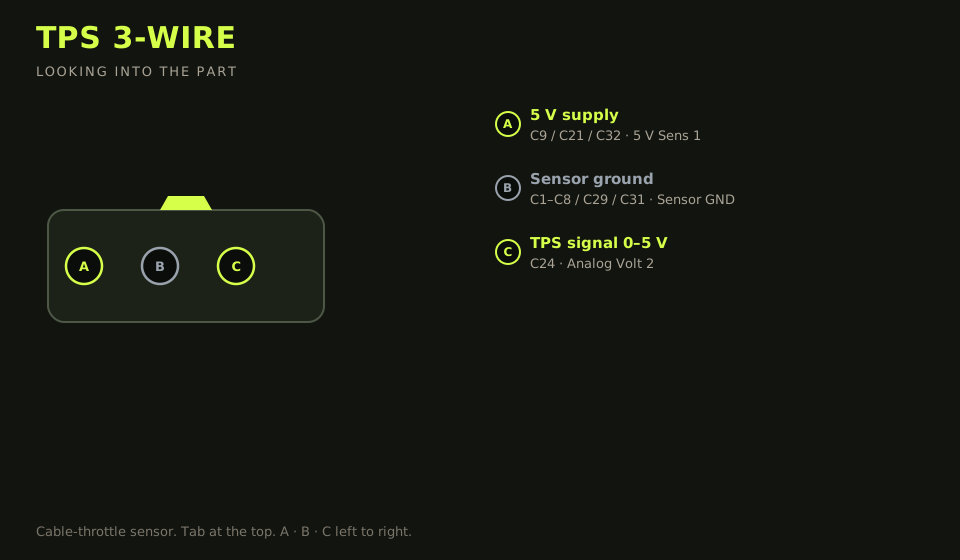
- Connector: 3-way on the throttle body or remote TPS
- Layout (looking into the part): A · B · C; polarising key top
| Device pin | Function | Type | Race Core | TunerStudio |
|---|---|---|---|---|
| A | 5 V supply | 5 V | C9 / C21 / C32 | 5 V Sens 1 |
| B | Sensor ground | Ground | C1–C8 / C29 / C31 | Sensor GND |
| C | TPS signal 0–5 V | Signal | C24 | Analog Volt 2 |
Wiring notes
- Closed throttle is typically 0.4–0.8 V, WOT 3.8–4.6 V. 0 V or 5 V is a broken wire or a short, not a calibration.
- Sweep must be monotonic. A dead spot in the middle is a worn track — replace the sensor, do not ‘calibrate around it’.
- ETB TPS 2 lands on Analog Volt 4 (C25) and 5 V Sens 2 (C10). Split the rails so a TPS short does not kill the pedal.
- If voltage falls as the blade opens, swap 5 V and ground at the sensor — or invert in software. Hardware swap is cleaner.
Failure modes
- Closed-throttle voltage at 0 V or 5 V: a wire is open or shorted. That is not a calibration issue.
- Voltage falls as the blade opens: 5 V and ground are swapped at the sensor, or the channel is inverted in software. Swap the wires.
- A flat spot in the middle of the sweep: worn track. Replace the sensor.
- ETB fault as soon as the pedal moves: TPS and APP are sharing one 5 V rail. Split Sens 1 and Sens 2.