Sensors & outputs Pressure
MAP — 3-bar GM
Manifold absolute pressure · sensor · Pressure
0–5 V absolute-pressure sensor. Default Race Core MAP is Analog Volt 1. A 3-bar (GM 12223861 family) covers NA through ~2 bar of boost. 1-bar and 2-bar parts share the pinout and need a different calibration.
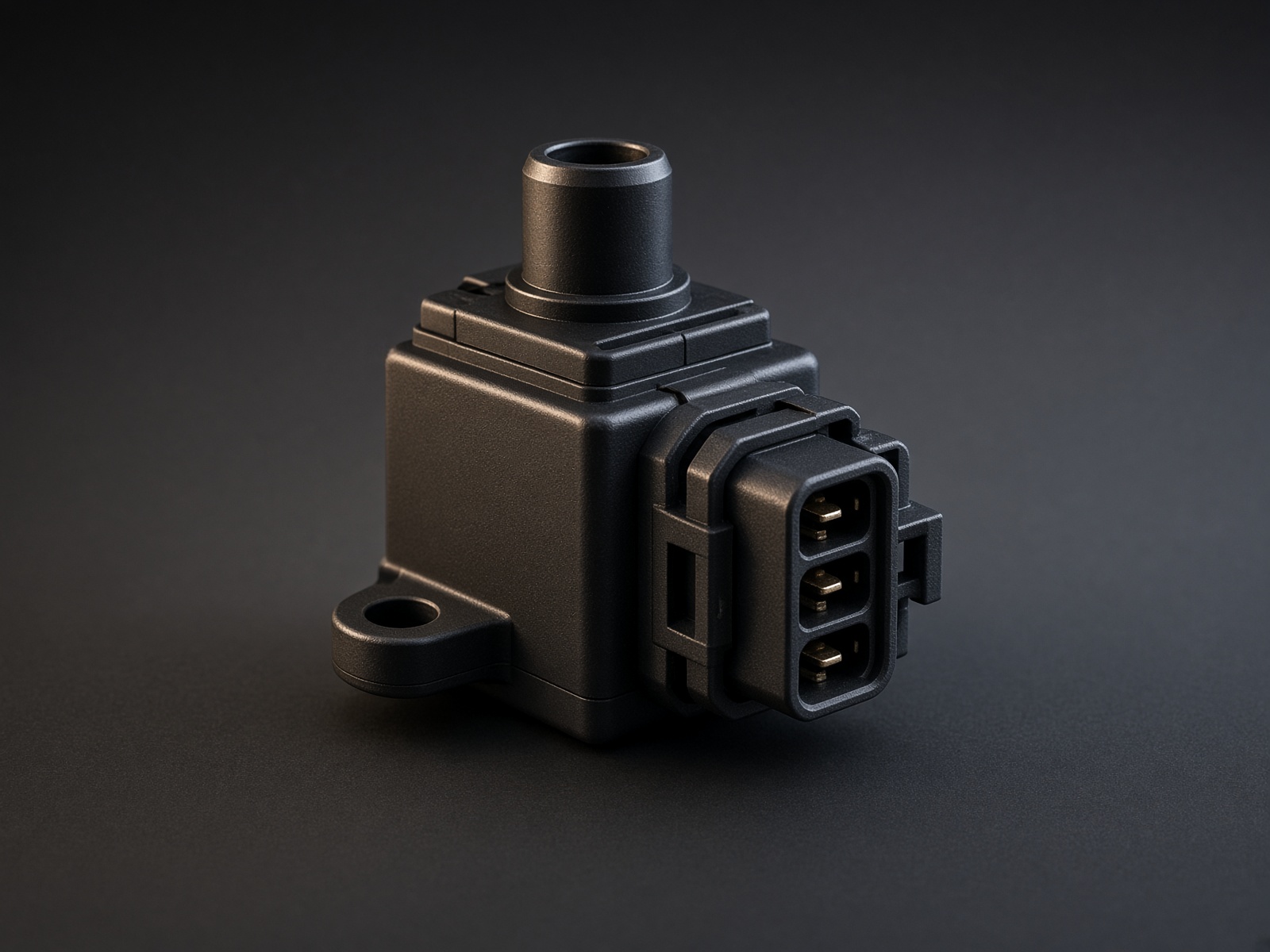
Typical parts: GM / Delphi 12223861 3-bar; GM 16040749; MSD 2313
Warning — Do not use power ground. MAP return is sensor ground on connector C. A block-strap return puts starter current in the MAP trace and looks like a random lean.
Device pinout
Looking into the sensor, locking tab at the top. Pins A · B · C left to right.
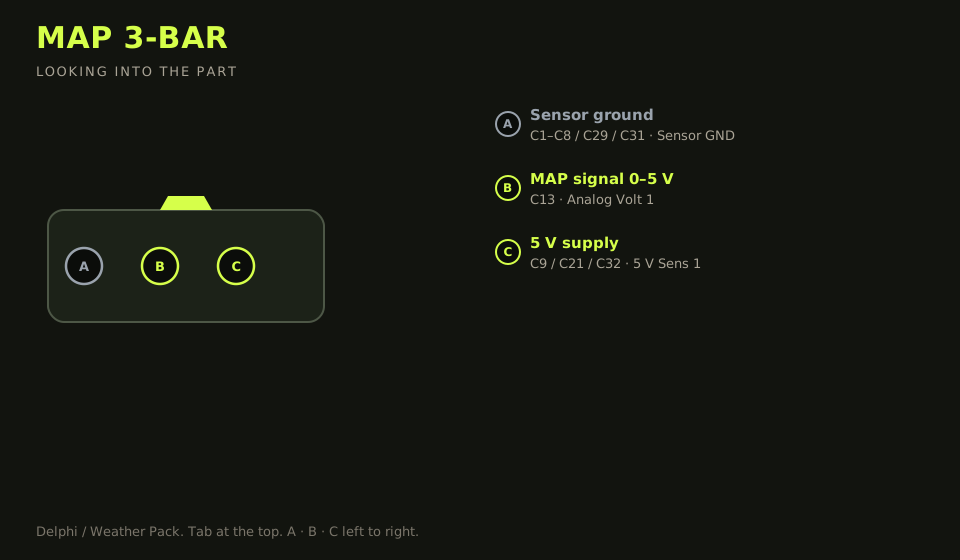
- Connector: Delphi / weatherpack 3-way on the sensor
- Layout (looking into the part): A · B · C; polarising key top
| Device pin | Function | Type | Race Core | TunerStudio |
|---|---|---|---|---|
| A | Sensor ground | Ground | C1–C8 / C29 / C31 | Sensor GND |
| B | MAP signal 0–5 V | Signal | C13 | Analog Volt 1 |
| C | 5 V supply | 5 V | C9 / C21 / C32 | 5 V Sens 1 |
Wiring notes
- GM 1 / 2 / 3-bar brick sensors share this pinout. Identify the stamp (749 / 861 = 3-bar) and set the calibration in TunerStudio — a 1-bar cal on a 3-bar sensor reads ~1/3 of real pressure.
- Key-on, engine-off MAP must agree with local atmospheric pressure (~100 kPa at sea level, mid-80s in Johannesburg).
- Hose to a dry manifold takeoff, not the fuel-pressure regulator tee. A wet hose reads boost late and dribbles fuel into the sensor.
- Gen IV LS MAP on the intake is a different connector. Same three functions; confirm A/B/C on that housing before you crimp.
Failure modes
- Key-on MAP near 0 V or 5 V: signal open, or 5 V shorted to the signal pin.
- Key-on MAP far from local atmospheric pressure: the calibration is for a different bar range. A 1-bar curve on a 3-bar sensor reads about a third of the truth.
- MAP jumps when the starter engages: the return is on power ground. Move it to sensor ground.
- Boost arrives late in the log: the hose is long, wet, or teed into the fuel-pressure reference.
See also
- Bosch P+T — a different sensor. Do not use the MAP calibration on a fluid sender.